




KAMALA
LEQEMBI PATIENT SINCE 2024
On this page:

To understand LEQEMBI,
take a look inside the brain
Alzheimer’s disease is a brain condition that gets worse over time, caused by a protein called
amyloid continuously building up in your brain and forming harmful amyloid brain plaque.
Though there are different types of amyloid proteins, all of them can damage brain cells.

Only LEQEMBI fights
Alzheimer’s disease in 2 ways


Different
amyloid
proteins

Amyloid
brain
plaque
For illustrative purposes only.
Individual results may vary.

LEQEMBI

LEQEMBI rapidly clears
amyloid brain plaque

LEQEMBI keeps working to clear
harmful amyloid proteins that
create brain plaque

People taking LEQEMBI were shown to have
less amyloid brain plaque starting at 3 months.
Watch how LEQEMBI works

Title card: LEQEMBI logo
VO: LEQEMBI and Alzheimer’s disease
LEQEMBI, (lecanemab-irmb), is used to treat people with mild cognitive impairment, also
known as MCI, due to Alzheimer’s disease and mild Alzheimer’s dementia.
Before you learn more about LEQEMBI, read this important safety information.
To understand how LEQEMBI works, it’s helpful to first understand more about what
causes Alzheimer’s disease.
Let’s start by taking a closer look at where it all begins, the brain.
This is an amyloid protein.
And these are too.
Amyloid proteins are a substance your brain makes all the time. When you’re healthy,
amyloid proteins are usually broken down and removed by the brain.
In people with Alzheimer’s disease, these proteins are sticky and continuously build up,
which can be harmful to the brain in two ways.
First, different types of amyloid proteins may clump together over time and damage brain
cells.
And second, larger clumps of amyloid proteins can eventually form harmful amyloid brain
plaque.
That makes it harder for brain cells to communicate with each other.
Over time, this buildup of amyloid brain plaque, and another protein that forms
tangles, can make it difficult to…
… do things like think, remember, and problem solve. So, it's important to take action early.
Title card: How LEQEMBI works
LEQEMBI fights Alzheimer's disease in two ways.
First, by targeting the different types of harmful amyloid proteins before they form into brain
plaque.
And second, by helping to remove existing amyloid brain plaque.
Because amyloid brain plaque continuously builds up…
… LEQEMBI keeps fighting throughout treatment to remove it.
That’s why discussing LEQEMBI early on is so important.
What is LEQEMBI? LEQEMBI is a prescription medicine used to treat people with early
Alzheimer’s disease, which include mild cognitive impairment (MCI) or mild dementia stage of
disease.
Important Safety Information. What is the most important information I should know
about LEQEMBI? LEQEMBI can cause serious side effects, including:
ARIA (Amyloid-Related Imaging Abnormalities). ARIA is a side effect that does not
usually cause any symptoms, but serious symptoms can occur. ARIA can be fatal.
ARIA commonly shows up as temporary swelling in areas of the brain that usually goes away
over time
Small spots of bleeding in or on the surface of the brain can occur
Less often, larger areas of bleeding in the brain can occur
Most people with ARIA don’t have any symptoms. However, some people may notice:
headache, confusion, dizziness, vision changes, nausea, difficulty
walking, seizures, difficulty speaking, muscle weakness
Some people have a gene called ApoE4 that may increase the risk of ARIA. Talk to your
healthcare provider about testing to see if you have this gene
You may be at a higher risk of developing bleeding in the brain if you take medicines to
reduce blood clots from forming (antithrombotic medicines) while receiving LEQEMBI. Talk to
your healthcare provider to see if any of the medicines you’re taking increase this risk
Your healthcare provider will check for ARIA with MRI (magnetic resonance imaging) scans
before you start LEQEMBI and during treatment
You should carry information that says you are receiving LEQEMBI, which can cause ARIA,
and that ARIA symptoms can look like stroke symptoms
Call your healthcare provider or go to the nearest hospital emergency room right away
if you have any of the symptoms mentioned previously.
Serious allergic reactions:
Do not receive LEQEMBI if you have serious allergic reactions to LEQEMBI, LEQEMBI
IQLIK, or any of the ingredients.
Tell your healthcare provider and get medical help right away if you notice any symptoms
during or after treatment with LEQEMBI, including: swelling of the face, lips, mouth, or
tongue; itchy bumps on the skin, also known as hives; difficulty breathing
Infusion-related reactions:
Infusion-related reactions are a common side effect that can occur during or after completion
with LEQEMBI injection into a vein (intravenously), which can be serious. Tell your
healthcare provider right away if you notice any of these symptoms: fever; flu-like symptoms
(chills, body aches, feeling shaky, joint pain); nausea and/or vomiting; dizziness or
lightheadedness; fast or slow heart rate, or feeling like your chest is pounding; difficulty
breathing or shortness of breath; changes in blood pressure
If you have an infusion-related reaction, your healthcare provider may give you medicines
before your next infusion to lower the chance of having a reaction
Injection-related reactions:
Injection-related reactions may occur with LEQEMBI injection under the skin (subcutaneous
injection with LEQEMBI IQLIK). Tell your healthcare provider if you notice any of these
symptoms during or after an injection: redness, swelling, heat, pain, itching, rash, bump,
bruising, and blood collection under the skin at the injection site; headache, chills, fatigue, or
fever may also be observed after an injection
The most common side effects of LEQEMBI include infusion-related reactions with
LEQEMBI injected into a vein, ARIA, and headache.
These are not all the possible side effects of LEQEMBI. Call your doctor for more
information and medical advice about side effects. You may report side effects to the
FDA at www.fda.gov/medwatch or call 1-800-FDA-1088.
Before receiving LEQEMBI, tell your healthcare provider about:
All your medical conditions, including if you are pregnant, breastfeeding, or plan to
become pregnant or breastfeed. It is not known if LEQEMBI could harm your unborn or
breastfeeding baby
All the medicines you take, including prescription and over-the-counter medicines,
vitamins, and herbal supplements. Especially tell your healthcare provider if you take
medicines to reduce blood clots from forming (antithrombotic medicines, including aspirin)
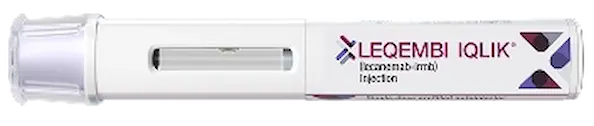
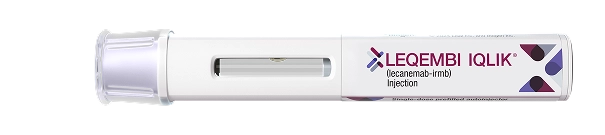
LEQEMBI (lecanemab-irmb) is available as:
Intravenous infusion: 100 mg/mL
Subcutaneous injection: 200 mg/mL
Please see Medication Guide with Instructions for Use and full Prescribing
Information, including Boxed WARNING, on LEQEMBI.com.
Explore study results with LEQEMBI
See results


Acting early gave me the
power to fight back...
FOR ME, AND THE
ONES I LOVE.
LEQEMBI PATIENT SINCE 2024